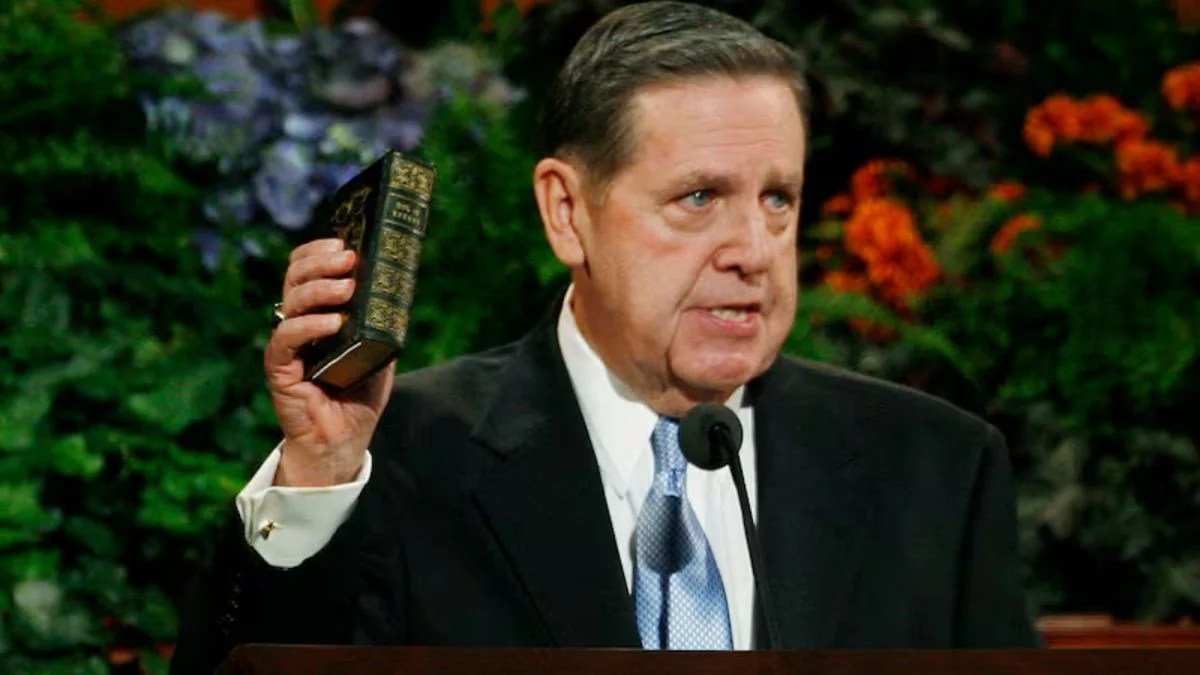
The ecclesiastical and theological history of The Church of Jesus Christ of Latter-day Saints during the late 20th and early 21st centuries is marked by a transition from a strictly insular, colonization-focused faith to a global religious movement. Central to this transition was the figure of Jeffrey Roy Holland.
Key Takeaways
- The Bridge Builder: Holland served as the bridge between academic rigor and pioneer spirituality, earning a Ph.D. from Yale while maintaining visceral faith.
- The Educator: From BYU President to Apostle, he revolutionized Mormon education and established the Jerusalem Center.
- The Defender: His "Safety for the Soul" sermon remains the definitive modern defense of the Book of Mormon.
- The Comforter: He destigmatized mental illness and offered hope to the broken, blending prophetic thunder with pastoral tenderness.
- The Legacy: From poverty in Yale to President of the Quorum of the Twelve, his life exemplified perseverance and divine calling.
Table of Contents
Introduction
The ecclesiastical and theological history of The Church of Jesus Christ of Latter-day Saints during the late 20th and early 21st centuries is marked by a transition from a strictly insular, colonization-focused faith to a global religious movement. Central to this transition was the figure of Jeffrey Roy Holland. An educator by trade, a scholar by training, and an Apostle by calling, Holland occupied a unique space in the Mormon hierarchy. He was the bridge between the intellectual rigor of the academy and the visceral, emotional spirituality of the pioneer tradition. His life, spanning from the red rocks of St. George, Utah, to the spires of Oxford and the pulpits of Salt Lake City, offers a microcosm of the Church's own maturation.
This report provides an exhaustive examination of Holland's life, career, and doctrinal contributions. It moves beyond a mere chronology to analyze the "why" and "how" of his influence. It integrates the "fun facts" of his biography—his athletic prowess, his legendary courtship, his poverty-stricken graduate years—not as trivia, but as essential context for understanding the man who would become the President of the Quorum of the Twelve Apostles. Furthermore, it provides a comprehensive exegesis of his most significant teachings on the Restoration, the Book of Mormon, missionary work, Jesus Christ, and the Atonement, synthesizing thousands of words of sermonizing into a coherent theological framework.
Part I: The St. George Foundation (1940–1960)
The Soil of "Dixie"
Jeffrey R. Holland was born on December 3, 1940, in St. George, Utah. To understand Holland, one must understand St. George. In the 1940s, it was not the retirement hub it is today; it was "Dixie"—a remote outpost of Mormon colonization characterized by intense heat, red sandstone, and a tight-knit, almost tribal community spirit. Holland was the son of Frank D. Holland and Alice Bentley Holland. His lineage was a convergence of the two primary streams of Mormon demographics: his mother came from a long line of pioneer stock, deeply rooted in the history of the exodus to the West, while his father was a convert to the Church. This dual heritage provided Holland with a native fluency in the culture of the Saints, yet perhaps instilled a sensitivity to the "outsider" perspective inherited from his father's conversion story.
Holland described himself during these years as an "average raised-in-the-Church, seminary-attending boy from southern Utah who had never really been anywhere". This self-deprecation, however, masks a youth of intense activity and early distinction. He was not a passive observer of his community; he was a central actor in its most important social ritual: high school athletics.
The Athlete and the Leader
In the cultural hierarchy of mid-century rural Utah, the varsity athlete was king, and Jeffrey Holland sat atop that hierarchy. He attended Dixie High School, where his engagement with sports was total. He lettered in football, basketball, track, and baseball. This was not merely recreational; it was a pursuit of excellence that foreshadowed his later intensity in the ministry.
Championship Pedigree: The 1959 athletic season at Dixie High School remains legendary in local lore. Holland was a key member of the "Flyers" teams that captured state championships in both football and basketball. This success required a blend of physical discipline, strategic thinking, and the ability to perform under pressure—traits that would later define his apostolic administration. His athletic career continued into his collegiate years at Dixie College, where he served as co-captain of the basketball team after his mission.
This background is significant for two reasons. First, it provided him with a reservoir of metaphors he would later deploy in his preaching—life as a contest, the need for stamina, and the glory of the "final whistle." Second, it established him as a natural leader among his peers, a "golden boy" of St. George who was comfortable in the spotlight and accustomed to carrying the expectations of a community.
The Courtship of Patricia Terry
The most pivotal event of Holland's high school years was not a touchdown or a basket, but the arrival of the Terry family in St. George. Patricia Terry, a gifted musician and cheerleader, moved to the area and immediately captivated the student body with her "kindness, talent, beauty, and spirituality".
The courtship between the "handsome, dimpled, and overly-confident sophomore athlete" and the new cheerleader is a foundational narrative in the Holland biography. They dated for two years prior to his mission. This relationship was the anchoring dynamic of his life. Patricia was not merely a supporting character; she was his intellectual equal and often his superior in spiritual sensitivity. Holland frequently acknowledged that she "fulfilled the measure of her creation more successfully than anyone could have dreamed possible". Their youthful romance, suspended by a two-year mission and solidified by marriage, became a model of Latter-day Saint courtship, blending romantic affection with shared religious purpose.
Part II: The Crucible of the British Mission (1960–1962)
If St. George was the foundation, the British Mission was the forge. In 1960, nineteen-year-old Jeffrey Holland left the insular safety of Utah for Great Britain. This assignment placed him in an environment where his faith was a minority position, requiring him to articulate and defend his beliefs daily.
The Influence of Marion D. Hanks
The mission president at the time was Marion D. Hanks, a General Authority known for his intellectual depth and dynamic speaking style. Hanks was a transformative figure for Holland. Unlike the rote memorization often associated with missionary work, Hanks demanded that his missionaries read, think, and understand the scriptures. Under Hanks' tutelage, Holland's love for the Book of Mormon and the Bible transformed from cultural acceptance to deep, theological conviction.
The Companionship of Prophets
A historical detail of immense significance is Holland's missionary companionship with Quentin L. Cook. It is a statistical rarity for two future members of the Quorum of the Twelve Apostles to serve as junior companions in the same mission, let alone as direct companions.
The "Legend" of Elder Holland: Elder Cook recalled that even as a young missionary, Holland was considered a "legend" in the mission. He possessed a "fabulous" talent for teaching the gospel and "enormous spiritual depth". Cook noted, "He was extremely good then, and there was nobody better in the Church at teaching". This period revealed Holland's innate rhetorical gifts. He didn't just teach; he captivated.
The two young men served together in leadership positions near the end of their missions. This companionship forged a bond of brotherhood that would last for more than sixty years. They spent their preparation days writing letters to Patricia Terry and Mary Gaddie, their respective future wives, dreaming of futures that would eventually see them sitting side-by-side in the highest councils of the Church.
The First Miracle
It was also in England that Holland first experienced the visceral power of the priesthood. Only two weeks into his mission, he and a companion were called to bless a woman who was slowly dying and in excruciating pain. Holland, young and inexperienced, participated in the blessing. The woman's pain ceased, and she slept for the first time in days. This "simple experience of faith and priesthood power" marked the transition from the theoretical religion of his youth to the practical, miracle-working faith of his adulthood.
Part III: The Scholar's Path (1963–1974)
Upon returning to the United States in 1962, Holland married Patricia Terry on June 7, 1963, in the St. George Temple. Ironically, his own parents missed the wedding because they were serving a mission in the very same British Mission where their son had just served. This detail underscores the generational commitment to missionary service in the Holland family.
Academic Ascent: BYU to Yale
Holland transferred from Dixie College to Brigham Young University (BYU), where he graduated with a bachelor's degree in English in 1965. He continued at BYU, earning a master's degree in religious education in 1966. His master's thesis focused on selected changes to the text of the Book of Mormon, an early indication of his lifelong intellectual engagement with the keystone scripture of his faith.
After a brief stint as an institute teacher in Hayward, California, and Seattle, Washington, the Hollands made a bold move: they headed east to Yale University.
The Yale Years and the "Old Car"
The move to New Haven, Connecticut, in 1970 was a leap of faith. Holland had been accepted into the Ph.D. program in American Studies, one of the most rigorous academic environments in the country. The family's financial situation was precarious, a reality that gave birth to one of the most famous anecdotes in modern Church history.
The "Old Car" Story: As the young family set out to cross the country, they packed their possessions into a small trailer and an "old car." Only 34 miles into the 2,600-mile journey, the car boiled over and broke down near Kanarraville, Utah. Holland walked miles to a town for water, returned, and they set off again—only for the car to explode again at the exact same spot.
Holland described the crushing sense of failure he felt as a young father, unable to provide even reliable transport for his family. A local man who helped them delivered a prophetic warning: "You might make that trip... but none of you are going to make it in that car".
Decades later, Holland would drive by that spot in a safe, reliable car with his wife asleep beside him. In his mind, he saw his younger self standing by the road. He wrote that he wanted to call out to that young man: "Don't you quit. You keep walking. You keep trying. There is help and happiness ahead". This story became a touchstone for Latter-day Saints struggling with poverty and discouragement, illustrating Holland's ability to weave personal vulnerability into theological encouragement.
"Don't you quit. You keep walking. You keep trying. There is help and happiness ahead."
— Jeffrey R. Holland
The "Nickel" Story: Another narrative from this impoverished era involves Holland stopping his "ancient car" to help a woman crying at a gas pump. She was distraught because she had dropped a nickel—a small sum, but enough to break her spirit in a time of hardship. Holland, though poor himself, helped her find it. This experience crystallized for him the reality of hidden burdens and the need for "regular people" to be God's angels.
Mark Twain and American Studies
At Yale, Holland studied under the renowned literary scholar R. W. B. Lewis. His dissertation analyzed the religious sense of Mark Twain, a topic that allowed him to explore the intersection of American culture and religious skepticism. He completed the program in a blistering three years, earning both a second master's degree and a Ph.D. in 1972, all while serving in a stake presidency and teaching institute classes. This academic pedigree distinguished Holland; he was not just a theologian but a trained cultural critic, capable of speaking the language of the secular university.
Part IV: The Educator and Administrator (1974–1989)
Holland's return to Utah marked the beginning of a rapid ascent through the Church's educational hierarchy.
Dean and Commissioner
In 1974, at the age of 33, he was appointed Dean of Religious Education at BYU. He immediately made his mark by establishing the Religious Studies Center (RSC), institutionalizing the serious study of Mormon scripture. Two years later, in 1976, he was named the Commissioner of the Church Educational System (CES), succeeding Neal A. Maxwell. In this role, he oversaw the religious education of young adults globally, bringing a "youthful vision and enthusiasm" to the bureaucracy.
The Presidency of Brigham Young University
In 1980, Jeffrey R. Holland was installed as the ninth president of BYU. His presidency (1980–1989) was a golden age for the university, characterized by academic maturation and high-profile expansion.
The Jerusalem Center: His crowning achievement was the establishment of the BYU Jerusalem Center for Near Eastern Studies. This project required navigating a diplomatic minefield, facing fierce opposition from Orthodox Jewish groups in Israel who feared the Center would be used for proselytizing. Holland's diplomatic skill and his assurance that the Center would be strictly academic were crucial in bringing the project to fruition. For his efforts in building bridges, he was later awarded the "Torch of Liberty" by the Anti-Defamation League of B'Nai B'rith.
Campus Life: Holland and Patricia were ubiquitous figures on campus. They were young, vibrant, and deeply involved in the lives of the students. Holland famously defended the university's unique mission, arguing that intellectual freedom and religious orthodoxy were not enemies but partners. His administration also saw the height of BYU's athletic fame, including the 1984 National Championship in football, which cemented the university's brand in the American consciousness.
Part V: The Apostolic Ministry (1994–2025)
After serving in the First Quorum of the Seventy starting in 1989, Jeffrey R. Holland was ordained an Apostle on June 23, 1994, by President Howard W. Hunter. For the next three decades, he served as a "special witness" of Jesus Christ.
The Firebrand and the Comforter
As an Apostle, Holland developed a reputation for a specific rhetorical style. He was capable of thunderous, prophetic warnings—defending the traditional family, the Book of Mormon, and moral purity with an intensity that reminded listeners of Old Testament prophets. Yet, he possessed an equal capacity for tenderness. He frequently spoke on mental health, depression, and loneliness, topics that had previously been somewhat taboo in Church discourse. His talk "Like a Broken Vessel" remains a landmark address for destigmatizing mental illness among Latter-day Saints.
The "Dodo" Controversy
Holland's willingness to engage with the secular world occasionally courted controversy. In a 2012 BBC interview for the documentary The Mormon Candidate, he was pressed on the historical claims of the Church. When the interviewer suggested Joseph Smith was a fraud, Holland retorted, "I'm not an idiot, you know... I'd like to think that your respect for me would be enough to know that this man doesn't seem like a dodo". While critics seized on the "dodo" phrasing, supporters viewed it as a moment of authentic, indignant defense of his own intellectual integrity and his testimony of the Prophet.
Leadership of the Quorum
Holland's seniority eventually placed him at the head of the Quorum of the Twelve. He was set apart as President of the Quorum on October 14, 2025. His leadership was brief but significant, marked by a continued emphasis on missionary work and the retention of the rising generation.
Part VI: Theological Pillar I — The Restoration and Joseph Smith
Holland's theology of the Restoration was binary and totalistic. He allowed no middle ground regarding the claims of Joseph Smith. For Holland, the validity of the Church hinged entirely on the reality of the First Vision.
Analysis of Teachings
Holland argued that the Restoration was not a metaphor but a literal historical intrusion of the divine. He often linked the validity of the current Church directly to the events of 1820.
Key Quotes:
"Take away Joseph Smith and the First Vision, take away the events which followed, take away a direct restoration from heaven, and what do we have? We don't have much—at least not enough to distinguish us from a thousand other good groups of people."
"We cannot reject Joseph Smith, nor forget him, nor omit him, nor try to tell our message without him without also rejecting the message and dismissing the powers that he brought."
"I testify that 15 men have succeeded Joseph Smith as prophets and Presidents of this Church... I declare that this, my personal witness, is the truth and that it has not come from man, but it has come from heaven."
"The promised Second Coming of the Savior began with the First Vision of the Prophet Joseph Smith in 1820. We can be certain that we are in the last days—years and years of them."
In these statements, Holland constructs a "chain of authority" argument. The link between the believer and God is mediated through the priesthood authority restored by Joseph Smith. To break the link with Smith is to sever the connection to the unique salvific power claimed by the Church.
Part VII: Theological Pillar II — The Book of Mormon
Perhaps no modern Apostle is as closely identified with the defense of the Book of Mormon as Jeffrey R. Holland. His background in literature gave him a specific appreciation for the text's complexity, which he often cited as evidence of its divinity.
"Safety for the Soul" (October 2009)
This sermon is widely considered his magnum opus on the subject. Delivered with palpable emotion and fierce conviction, Holland addressed critics who dismissed the book as 19th-century fiction.
Analysis and Quotes:
"I want it absolutely clear when I stand before the judgment bar of God that I declared to the world… that the Book of Mormon is true."
Holland employed a "dying declaration" argument, focusing on the martyrdom of Joseph and Hyrum Smith. He argued that men do not go to their deaths clutching a book they know to be a lie.
"Never mind that their wives are about to be widows and their children fatherless... Disregard all of that, and tell me whether in this hour of death these two men would enter the presence of their Eternal Judge quoting from and finding solace in a book which, if not the very word of God, would brand them as imposters and charlatans until the end of time? They would not do that! They were willing to die rather than deny the divine origin and the eternal truthfulness of the Book of Mormon."
"If anyone is foolish enough or misled enough to reject 531 pages of a heretofore unknown text teeming with literary and Semitic complexity without honestly attempting to account for the origin of those pages... he or she has been deceived."
"God always provides safety for the soul, and with the Book of Mormon, He has again done so in our time. Remember this declaration by Jesus Himself: 'Whoso treasureth up my word, shall not be deceived'... and in the last days neither your heart nor your faith will fail you."
Holland viewed the Book of Mormon as the primary mechanism for spiritual survival—"safety"—in the last days. It was not just a history; it was a shield.
Part VIII: Theological Pillar III — The Theology of Missions
As a former missionary who revered his own mission experience, Holland held a high and demanding view of missionary service. He rejected the notion that missions should be easy or comfortable.
The "Cost" of Salvation
Holland developed a theology of "suffering for the cause." He argued that because Christ suffered for the salvation of mankind, those who labor to bring that salvation to others must expect to taste a portion of that suffering.
Key Quotes:
"I am convinced that missionary work is not easy because salvation is not a cheap experience. Salvation never was easy. We are The Church of Jesus Christ, this is the truth, and He is our Great Eternal Head. How could we believe it would be easy for us when it was never, ever easy for Him?"
"You only get one chance to serve a mission; it is your responsibility, your duty, to use it to the fullest; to give every last ounce of energy until you collapse in exhaustion at the end of it."
"It is by definition the most important thing you can do in the world, in time or eternity. For this reason you are engaged in the saving of the human soul. And that is the highest and holiest work in the universe."
"When the Lord delivers this person to your view, just chat—about anything. You can't miss. You don't have to have a prescribed missionary message. Your faith, your happiness, the very look on your face is enough to quicken the honest in heart."
While his demands were high ("collapse in exhaustion"), his practical advice was often humane. He encouraged missionaries to be normal and conversational ("just chat"), bridging the gap between high theology and daily social interaction.
Part IX: Theological Pillar IV — Christology and The Atonement
Holland's most profound theological work focused on the Atonement of Jesus Christ. He sought to explain the mechanism of Christ's suffering, particularly the cry of abandonment on the cross.
"None Were With Him" (April 2009)
In this landmark sermon, Holland addressed the question: "Why did God forsake Jesus?" His answer was a sophisticated theological distinction between "abandonment" and "withdrawal of the Spirit."
Analysis and Quotes:
"Trumpeted from the summit of Calvary is the truth that we will never be left alone nor unaided, even if sometimes we may feel that we are."
Holland posits that the Atonement required Christ to experience the totality of human experience, including the loss of the Spirit that follows sin.
"I speak of those final moments... that concluding descent into the paralyzing despair of divine withdrawal when He cries in ultimate loneliness, 'My God, my God, why hast thou forsaken me?'"
"With all the conviction of my soul I testify that He did please His Father perfectly and that a perfect Father did not forsake His Son in that hour. Indeed, it is my personal belief that in all of Christ's mortal ministry the Father may never have been closer to His Son than in these agonizing final moments of suffering."
"Nevertheless, that the supreme sacrifice of His Son might be as complete as it was voluntary and solitary, the Father briefly withdrew from Jesus the comfort of His Spirit, the support of His personal presence."
"It was required, indeed it was central to the significance of the Atonement, that this perfect Son who had never spoken ill nor done wrong nor touched an unclean thing had to know how the rest of humankind—us, all of us—would feel when we did commit such sins... to sense what it was like to have the divine Spirit withdraw, leaving one feeling totally, abjectly, hopelessly alone."
This teaching—that the Father was close but withdrew His Spirit for the sake of the Atonement's completeness—provided a framework for understanding divine silence in the lives of believers. It reframed loneliness not as a sign of God's absence, but as a path Christ had already walked.
Part X: Practical Theology — Angels, Depression, and Hope
Holland's ministry was notable for its engagement with the lived reality of members' struggles. He moved theology out of the abstract and into the clinical and the domestic.
The Ministry of Angels
Holland taught that the veil between heaven and earth is thin and that "angels" are not merely scriptural figures but active participants in daily life.
Key Quotes:
"I testify that angels are still sent to help us, even as they were sent to help Adam and Eve... Usually such beings are not seen. Sometimes they are. But seen or unseen, they are always near."
"When we speak of those who are instruments in the hand of God, we are reminded that not all angels are from the other side of the veil. Some of them we walk with and talk with—here, now, every day."
"Ask for angels to help you."
Hope for the Broken
Holland was the Apostle of the "second chance." He relentlessly preached hope to those dealing with sin, depression, or failure.
"However late you think you are, however many chances you think you have missed, however many mistakes you feel you have made... His concern is for you individually and personally."
"To be grateful in times of distress does not deny the pain of the moment. It is to declare that faith and divine assurance will see us through."
"Don't you quit. You keep walking. You keep trying. There is help and happiness ahead."
Part XI: Final Years and Legacy (2023–2025)
The final chapter of Jeffrey R. Holland's life was defined by the loss of his eternal companion and his own physical decline, yet he remained active in his ministry.
The Death of Patricia
On July 20, 2023, Patricia Terry Holland passed away. Her death was a severe blow to Holland. In a poignant revelation, he admitted to enduring a major medical crisis of his own within 48 hours of her burial, a testament to the physical toll of grief.
Final Leadership
Despite his health challenges, including dialysis, Holland assumed the role of Acting President of the Quorum of the Twelve in November 2023.
Many people are unaware of the recent miracle that occurred to Jeffrey R. Holland in October 2024. Prior to his assignment in the Dominican Republic, President Holland was still dealing with serious COVID-19 health problems in addition to his coma. He requested a blessing before starting his assignment, and those who were traveling with him reported that the plan was to arrive in the DR and take a nap before the meetings. President Holland told the company it was time to go minister after they disembarked from the aircraft. He had fresh vigor, strength, and concentration throughout the entire journey. His ministry and vitality were sustained until his death by a miracle. His talk and interaction with the saints in the DR were described by many as being similar to the "old" Elder Holland, indicating that his zeal, charisma, and energy had returned.
He continued to work, even serving as grand marshal of the Days of '47 Parade in July 2025.
Passing
President Jeffrey R. Holland passed away on December 27, 2025, at the age of 85. He died surrounded by his family, leaving behind a legacy as one of the most influential teachers and witnesses in the history of the Restoration.