Table of Contents
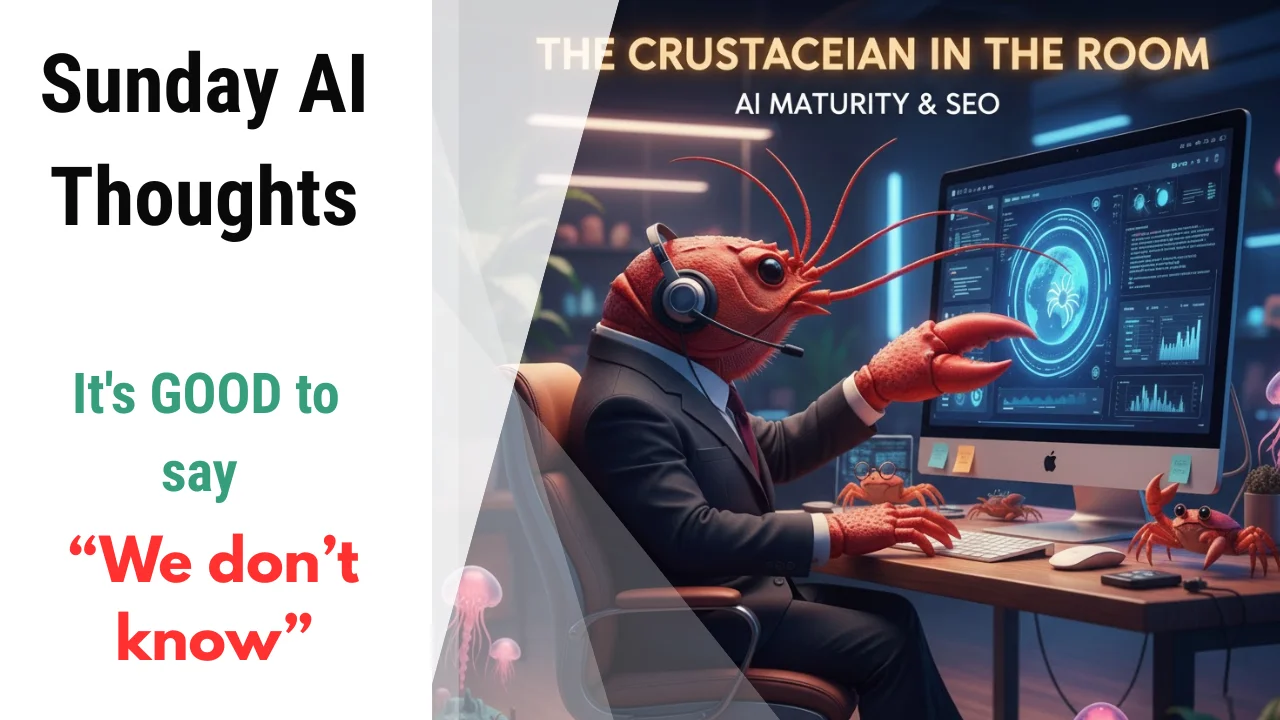
Lately, the SEO industry feels like a high-speed biology exhibit. Every week, there's a "new creature," "critter," or branded "crustacean" (like an autonomous agent or an agentic cluster running local models) promising to revolutionize your workflow. For those of us at the tip of the spear, this is exhilarating. We are ingesting these changes rapidly, but we must recognize a hard truth: the broad population—and specifically, your clients—are not.
The Pitfall of the "Sexy" AI Solution: Aligning with AI Maturity
As early adopters, we often suffer from "tunnel vision." We see a fully autonomous, agentic SEO auditor and immediately think, "This is the future of SEO strategy."
But if you try to force that "sexy" solution onto an organization that is still just learning to use Large Language Models (LLMs) to draft basic emails, you aren't helping them—you're creating friction. My 14-year career in digital marketing has taught me that sustainable growth requires meeting people where they are.
The Core Mission: We must cater our messaging to where the client actually sits on the AI Maturity Scale. If we accelerate a stakeholder beyond their current capacity, we aren't building a partnership; we're inducing fear. Fear doesn't move the needle; education and incremental success do.
Building Turnkey AI Operations, Not a "Consultant Loop"
There is a dangerous trend in AI consulting: the "Systems Project" that leaves the client stranded. If you implement a complex agentic cluster for a client, take their payment, and then walk away, you've left them with a liability, not a sustainable asset.
- The Goal: We should be building turnkey AI operations that your clients can manage.
- The Reality: If a client isn't fully equipped to manage the system without you in the loop, you haven't set them up for success.
- The Philosophy: We must meet their AI maturity where it stands today to ensure the AI tools we build actually stick and provide long-term SEO value.
Grounding SEO Speculation in Empirical Data
The SEO world is currently drowning in speculation. We hear constantly about how "search is dead" or how agentic search will replace the traditional SERP. While things are moving at a breakneck pace, we need to ground our decisions in empirical data.
We are in the early collection phase. We are still figuring out what actually moves the needle in this new era. We need to be asking the hard questions:
- Does specific schema markup play better with agentic search?
- How do we optimize for LLM visibility?
- What is the "secret sauce" for SEO in 2026?
The honest answer? We aren't there yet. I am a heavy user of these tools, but anyone claiming they have a 100% proven formula for the "Agentic Era" is selling you a dream.
The Coming Equilibrium
The "dust" will eventually settle. We've seen billions of dollars poured into AI startups, and not all of them are seeing a return yet. An equilibrium is coming where we will finally understand the permanent place these "crustaceans" have in our workflows.
Until then, we need to test and figure this out together. Relax, take a breath, and realize that while AI changes SEO, the fundamental need for clear communication and strategic alignment has never been more vital.
Platform Mission: This platform's mission is to cut through the noise, reduce ambiguity, and share insights from over a decade of technical SEO experience.
Watch: More Thoughts on AI Maturity in SEO
Dive deeper into how AI is reshaping the SEO landscape and why organizational readiness matters: